Guide
How to charge for shop supplies and disposal fees
Consumables and waste are real costs that arrive job by job and get recovered by nobody unless you decide how.
The short answer
Work out what you actually spend before you decide how to charge for it. Take a month of receipts, pull out everything consumed by jobs but billed to none of them, and divide by the number of jobs you did. That figure is the thing being recovered, and once you have it the choice of method is easy to make and easy to defend.
Then pick one of two methods and stay with it. Either build the cost into your labour rate so it never appears as a line, or show it as a named charge on every estimate and every invoice. Both are used, both are defensible, and mixing them is what produces the invoice nobody understands.
Treat disposal as a different question from consumables. Consumables are what you use up. Disposal is what somebody charges you to take waste away, and it lands on particular jobs rather than on all of them evenly. Price it from what your own waste contractor bills you, not from a number you read somewhere.
Whatever you decide, the customer sees it before the work rather than at the end. Almost every complaint about these charges is a complaint about a surprise, and a line on an approved estimate is not a surprise.
What the charge is actually paying for
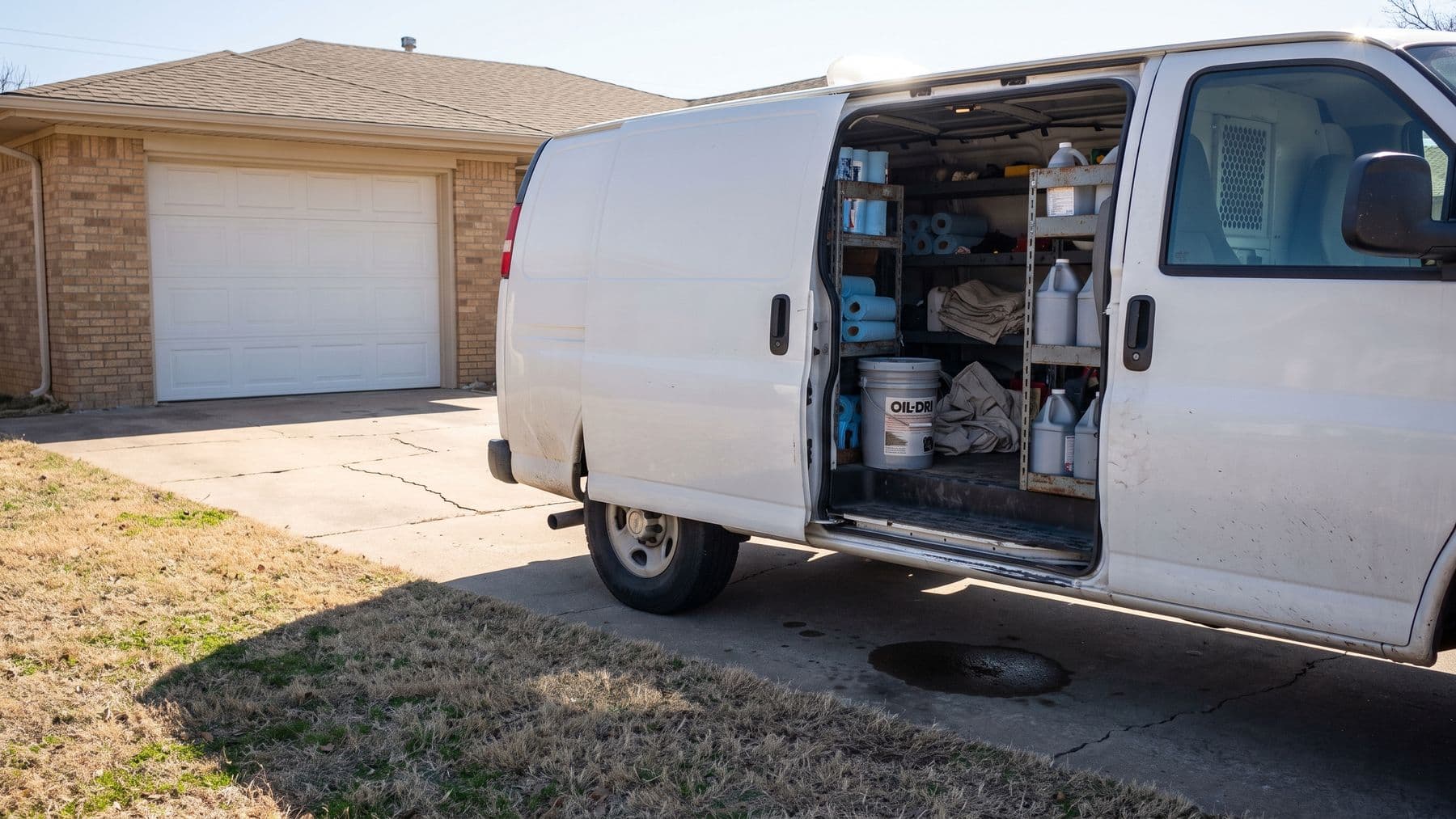
A repair consumes a long list of things that never appear on a parts invoice. Brake cleaner, penetrating fluid, gloves, rags, wire, tape, zip ties, fasteners, sealant, thread lock, sandpaper, drill bits, blades, solder, small quantities of grease and fluid, the shop towel that is now ruined, and the fastener you had to replace because it sheared.
None of those is large. All of them together are a real monthly number, and it is one of the few costs in this trade that is almost always absorbed silently, because each individual item is too small to think about at the moment it is used.
That is why a charge for it exists at all. It is not an extra margin invented by shops, it is an attempt to recover a category of spending that would otherwise be invisible in the accounts and therefore never priced.
Which also tells you when the charge is being misused. If it is applied to jobs that consume nothing, or set at a level far above what is being consumed, it stops being cost recovery and becomes a price increase wearing a technical name, and customers are quite good at sensing that.
Why this page names no percentage
The common way to express a supplies charge is as a proportion of the labour on the job, on the reasoning that a longer job consumes more of everything. You will see figures quoted freely online and in forums, usually with no source and no indication of who was surveyed.
This page gives none of them, for two reasons. The first is that nothing here has measured what anybody charges, and repeating an unsourced number gives it a second life it did not earn. The second is more useful to you: a percentage copied from a shop with a building, staff and a stockroom is describing a different cost structure from a van, and your consumables spend per job is a number you can actually obtain in about twenty minutes.
So the method below produces your figure. If you then want to express it as a proportion of labour, divide your per job consumables cost by the labour you typically bill on a job and you have a proportion that is derived from your own spending rather than from somebody guess.
Disclosure is what turns a fee into an argument
The predictable failure with these charges is not the amount. It is a customer who agreed to one figure and received an invoice with an extra line they had never seen, and who now feels that the price they were told was not the real price.
The fix costs nothing. The charge appears on the estimate, in words the customer can understand, before they approve anything. If it is a proportion, say what it is a proportion of. If it is a flat amount, say so. If it has a ceiling, say what the ceiling is.
Several states have specific rules about how charges of this kind are described and disclosed on repair documents, and some regulate them directly. This page does not state what any of those rules say. Read what your own state repair regulator publishes, because that is the only version that governs your paperwork.
What actually goes in the shop supplies bucket
The exercise takes one evening and it produces the only figure on this subject that is really yours.
Take a month of receipts and card statements. Pull out every purchase that was consumed doing work but was not billed to a specific job. Chemicals and cleaners. Abrasives and blades. Fasteners, clips and connectors bought in boxes rather than for one car. Gloves, rags and wipes. Tape, wire, heat shrink, cable ties. Small quantities of fluid used for topping up rather than for a service. Sealants and adhesives. Anything you keep in the van because you know you will need some of it this week.
Do not put tools in the bucket. A socket set lasts years and belongs in your overhead or in your rate, not in a per job charge. The test is whether it gets used up. A blade is used up. A grinder is not.
Do not put in anything you already bill directly. Oil sold as part of a service, a filter, a specific part for a specific car: those are on the invoice already and counting them twice is how a fee becomes indefensible.
Now divide the total by the number of jobs you completed in that month. The result is your average consumables cost per job. Do the same for a second month before you rely on it, because one month with a big chemical order in it will mislead you.
Look at the spread as well as the average. If most of the spending is caused by a minority of jobs, an even charge across all jobs is the wrong shape and you may want the charge to scale with labour, or to apply only to the job types that actually consume things. A software installation on a car that never got dirty consumes nothing, and charging it a supplies fee is the version customers complain about.
Recovering it in the rate, or naming it as a line
Once you know your figure, there are two honest ways to collect it, and the choice is more about how you want to be seen than about arithmetic.
Building it into the labour rate is the quiet option. Your rate rises by roughly what the consumables cost per hour of work, and no extra line ever appears on an invoice. The customer sees one price for your time and pays it. Nobody argues about a rate the way they argue about a fee, because a rate is understood to include the cost of doing the work.
The argument against is transparency in the other direction. You lose the ability to point at what a job consumed, and when you eventually raise the rate for real reasons it is doing two jobs at once. Some readers also find that burying it makes them stop tracking it, and an untracked cost drifts.
Naming it as a line is the explicit option. It shows the customer what they are paying for, it lets the charge scale with the job, and it keeps the cost visible to you month after month, which makes it easier to notice when consumable prices move.
The argument against is that any line item invites a question, and a line with a vague name invites a suspicious one. If you name it, name it in plain words, keep it proportionate to what the job really consumed, and be ready to say in one sentence what it covers. A charge you can explain in a sentence almost never becomes a dispute.
What does not work is doing both, or applying the line inconsistently. Charging it to the customers who do not query things and dropping it for the ones who do is not a pricing policy, it is a habit that teaches your best customers that your prices are negotiable and your others that they were overcharged.
One more practical point. If you use a flat amount rather than a proportion, revisit it on a schedule. Chemicals and consumables move with everything else, and a flat figure set two years ago is now recovering less than it did without anybody deciding that.
The disposal side is somebody else invoice arriving at your door
Disposal is not consumables and should not be folded into the same line, because it behaves differently. It is caused by specific jobs, it is a cost somebody else sets, and how it may be handled is regulated in ways consumables are not.
The materials are the familiar ones: used oil and filters, coolant, brake fluid, transmission fluid, batteries, tires, and sometimes refrigerant and airbag components which have their own handling requirements entirely.
A mobile mechanic has a problem a shop does not: you generate the waste at the customer address and carry it away with you. Where it goes next is your responsibility, and the practical answers range from a collection centre that takes some materials from the public, to a dealer or parts store that accepts certain items, to a waste contractor who invoices you.
Price it from what it actually costs you. Get the invoice or the schedule from wherever you take each material, work out the cost per unit you generate, and attach it to the jobs that generate it. A tire job creates a tire to dispose of. A brake fluid flush does not.
Charge it as a pass through and say that is what it is. Disposal is the easiest charge on any repair invoice to explain, because everybody understands that getting rid of five quarts of used oil is not free. Customers who bristle at a vague supplies percentage rarely argue about the line that says what happened to their old tires.
Two things to be careful with. Some materials attract charges that are set by somebody other than you and change without notice, so check the schedule rather than remembering it. And what you may transport, store and hand over, and what documentation goes with it, is governed by rules that vary by state and by material. Find out what applies to you from your state environmental agency or your waste contractor before it becomes a question somebody asks you in an unfriendly context.
Finally, keep the customer old parts question separate from the disposal question. If somebody wants their old components back, they are not asking you to dispose of anything, and the paperwork on the job should say which of the two is happening.
Where the short answer stops being the answer
Every rule on this page has a situation it does not survive. Here are the ones worth knowing about before you meet them.
The customer supplied the parts and expects to supply the supplies too
A customer who brought their own component sometimes concludes that nothing else on the invoice is legitimate either. Separate the two: the parts they supplied are theirs, and the chemicals, fasteners and fluids you consumed fitting them are yours and were bought by you.
This is easier when your position on supplied parts is already written down and was shared before the booking. There is a guide in this cluster on that, and the two policies are worth agreeing at the same time.
A fleet or trade customer refuses to accept fee lines
Business customers frequently want a single labour rate with nothing added, because their own approval process treats extra lines as exceptions. That is a legitimate request and it is easier to satisfy than to argue with.
Quote them a rate that already contains your consumables figure. You are recovering the same money by a different route, and both sides get what they wanted. Do the arithmetic first so you know what the rate has to be, rather than absorbing the cost to win the account.
The job is a comeback under your own warranty
You are still consuming chemicals and fasteners on a return visit, and you are still generating waste, but charging a supplies fee on a job the customer is not paying for reads badly and earns you very little.
Decide the rule once and write it into your warranty terms, so that it is a policy rather than an argument at the door. Most people absorb it, and the sensible way to make that painless is to have priced comebacks into your rate in the first place.
A proportion produces a strange amount at the extremes
A charge tied to labour becomes trivial on a very short job and conspicuous on a very long one, and neither extreme reflects what was consumed. This is why ceilings and minimums exist on these charges.
If you use them, put both in writing with the charge itself, so the customer sees the shape of it before approving. A ceiling that appears only when it happens to help you looks improvised.
When it has already gone wrong
Most people find a page like this after the fact rather than before it. This part is for them.
The customer is seeing the charge for the first time on the invoice
Explain what it covers in one plain sentence and, if this is the first time they have seen it, consider removing it on this occasion rather than winning the point. The line is worth less than the review.
Then fix the cause the same week, which is always the same fix: the charge belongs on the estimate the customer approved, in the same message as the price they said yes to.
You have no idea whether the amount you charge is right
If the figure came from a forum, another shop or nowhere in particular, you cannot defend it and you do not know whether it covers anything. Run the receipts exercise above once and you will have a number that is genuinely yours.
You may well find the charge you have been making is under what you spend. That is the common outcome, and it is worth knowing before the next time you consider raising your labour rate.
Somebody has publicly called it a junk fee
Respond factually and without defensiveness: what the charge covers, that it was on the estimate they approved, and what it worked out at on their job. Onlookers judge the tone more than the argument.
Then look honestly at whether the criticism has a point. A charge applied to a job that consumed nothing, or one nobody was told about, deserves the complaint. If both of those are already handled, the occasional objection is just the cost of naming a real cost out loud.
Questions
What is a shop supplies fee?
It is a charge intended to recover the things a repair uses up that never reach a parts invoice: cleaners, lubricants, fasteners, abrasives, tape, gloves, rags and small quantities of fluid. It exists because those costs are real and are otherwise invisible, and it is misused when it is applied to jobs that consume nothing.
How much should I charge for shop supplies?
This page states no percentage and no amount, because nothing here has measured what anybody charges and a figure from a shop with a building describes a different cost structure from a van. Take a month of receipts, total what was consumed by jobs but billed to none of them, divide by the jobs you did, and you have your own figure.
Can a mobile mechanic charge a disposal fee?
Charging for waste disposal is ordinary practice, and the most defensible version is a pass through of what it actually costs you to get rid of that material. How such charges must be described, and what you are permitted to transport and hand over, is set by state and by material, so check with your state environmental agency and with whoever accepts your waste.
Should shop supplies be in my labour rate instead of a separate line?
Both are used. Inside the rate means no extra line and no questions, at the cost of visibility. As a named line it is transparent and scales with the job, at the cost of inviting a question you have to be able to answer in a sentence. Pick one and apply it to everybody rather than deciding customer by customer.
Do I have to tell the customer about the fee in advance?
What disclosure is required is a state question and this page does not answer it. What is certain in practice is that a charge nobody saw before approving the work is the version that turns into a dispute or a bad review, so put it on the estimate whatever your state says.