Guide
What tools do you need to start mobile mechanic work
The right list is not a list somebody else wrote. It is whatever the first month of jobs actually requires, plus the two categories nearly everybody underbuys.
The short answer
Work backwards from the jobs you intend to say yes to. Write down the ten repairs you expect to be asked for most often in your first month, then write down what each one physically requires. That list is your list. It will be shorter than any published starter list and it will contain two or three things no published list mentioned, because it is built from your work rather than from somebody else work.
Then sort what you have written into three piles. Things you cannot do the job without and therefore buy now. Things you can rent, borrow or hire for the one job that needs them. Things that mean the job is not for you yet, which is a legitimate pile and the one people are most reluctant to use.
Buy the access and safety equipment before anything else. A mobile mechanic works on the ground in places that were never designed for it, and the means of getting a vehicle safely up and keeping it there is the part of the kit where being cheap is genuinely dangerous rather than merely annoying.
This page names no prices. Tool cost depends on brand, condition, where you buy and what you are prepared to wait for, and any figure printed here would be a guess with a decimal point on it. What the page does instead is give you the arithmetic for deciding whether a particular tool is worth buying yet, from your own jobs and your own rates.
The order to do it in
- 1
Write down the work you will actually accept
Not the work you are capable of. The work you intend to advertise and say yes to in the first month. Brakes, batteries and starters, fluid and filter services, belts, alternators, suspension components, pre purchase inspections, diagnosis of a warning light. Yours will be different and that is the point.
This is the same decision as the one behind your pricing and your marketing, so if you have already made it for those, use the same list rather than a new one.
- 2
Turn each job into what it physically requires
Go through them one at a time and say out loud what the job needs. Not categories, specific things. Which sockets and which drive. Whether it needs a torque wrench and in what range. Whether it needs a press, a puller, a scan tool that can talk to the module, a spring compressor, a bleeder.
Doing this on paper takes an evening and it is the single most valuable evening in the whole exercise, because it converts an abstract worry about being underequipped into a finite list of items.
- 3
Sort into buy, hire and decline
Anything that appears in most of your ten jobs goes in the buy pile. Anything that appears in one job, and is expensive, starts in the hire pile. Anything that needs equipment you cannot get to the roadside at all goes in the decline pile until the business is bigger.
The decline pile is not a failure. Deciding in advance which jobs you turn down is what stops you from accepting one on the phone and then discovering the problem at the vehicle, which is the worst possible place to discover it.
- 4
Buy the access and safety equipment first
Lifting, supporting, chocking and protecting yourself come before any convenience tool, because the failure mode is different in kind. Everything else on the list costs you a job. This category costs you something else.
It also includes the unglamorous items: eye protection, gloves, a fire extinguisher you can actually reach, something to make you visible at the roadside, and something to protect the surface you are working on.
- 5
Solve power and light before you solve anything clever
You will work in the dark, in a car park with no outlet, in the rain, under a car in the middle of the afternoon where it is still somehow too dark to see the fastener. Portable power and good light are the two things that turn a possible job into a finished one.
This is also the category where a small upgrade changes your day more than an expensive specialty tool would, because it applies to every job rather than to one of them.
- 6
Solve finding things and carrying things
A tool you own and cannot find is a tool you do not own. The organisation of the van decides how long each job takes far more than the quality of any individual tool does, and it is the part of the kit that gets no attention because it is not exciting to buy.
The test is simple and worth doing honestly: can you put your hand on any given item in under a minute, and can you tell at the end of the day whether something has been left on somebody driveway.
- 7
Let the jobs buy the rest
From here on, a tool gets bought when the work has asked for it more than once, or when the maths in the section below says it has earned its place. Not when it is on offer, and not because a list said a professional should own one.
Keep a running note of every job you turned down for want of a tool. That note, after a month or two, is the most accurate buying list you will ever have, because it is written by your actual customers.
Why a generic starter list is the wrong shape
A published list has to serve everybody, so it contains the union of what several different kinds of mechanic need. You are one kind. The union is much larger than your set, and the difference is money spent on equipment for work you will never be offered.
It is also missing things. A list written for shop work quietly assumes a lift, a compressor on the wall, a bench, a vice, a press in the corner and somebody who can go and get something. None of those assumptions survives a driveway, and the substitutes for them are exactly the items that never appear on a generic list.
The derivation from your own jobs fixes both problems at once, and it has a side effect that matters more than the money: it forces you to decide what work you accept before a customer decides it for you.
The two categories almost everybody underbuys
The first is getting the vehicle safely off the ground and keeping it there on a surface you did not choose. Driveways slope, grass is soft, kerbs are uneven and gravel does what gravel does. The equipment that is fine on a flat shop floor is not automatically fine on a slope in the rain, and this is the one place on the whole list where saving money buys you a risk rather than an inconvenience.
The second is power and light. Mechanics with a shop background underestimate this consistently, because they have never had to think about where electricity comes from. Every cordless thing you own has a battery that will be flat on the third job of the day, and there is no outlet on a residential street.
Both categories share a property that makes them easy to postpone: neither of them is job specific, so neither of them shows up when you list the tools a particular repair needs. They apply to all of the jobs, which is precisely why they are worth buying properly.
Renting, borrowing and declining are all legitimate answers
The instinct when a job needs a tool you do not have is to buy it, because owning it feels like being a real mechanic. Frequently the better answer is to hire it for the day, and the difference goes straight into your pocket.
Loan tool programmes, tool hire and borrowing from somebody you trained with are all normal parts of running a small operation, and none of them makes you less professional. What matters is that the job still gets done properly and safely.
Declining is the answer people find hardest and it is often the correct one. A job that needs equipment you cannot bring to a driveway is not a job you lost, it is a job that was never yours, and the version where you accept it and improvise is the version that damages a car.
Say no clearly and quickly when you do say it. A customer told on the phone that this particular repair really needs a workshop will frequently call you back for the next thing, and may well tell somebody else that you were honest.
The van is a tool, and it decides more than the tools do
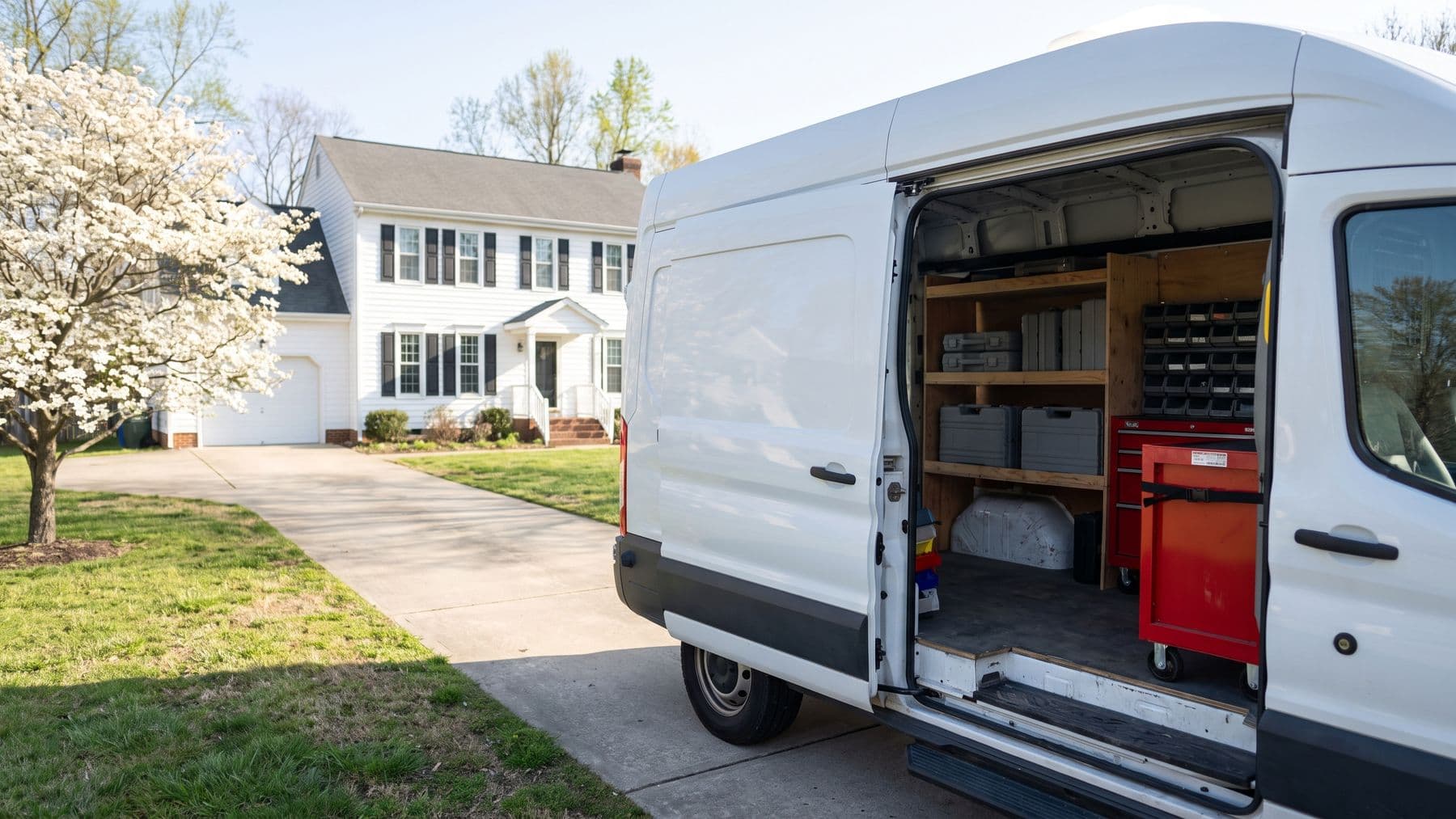
People treat the vehicle as transport and the contents as the kit. In practice the van is the largest single item of equipment you own, and how it is arranged decides how long every job takes for as long as you own it.
Layout first. Everything you use on most jobs wants to be reachable without climbing in, and everything heavy wants to be low and forward. That is not neatness, it is the difference between a job taking the time you quoted and a job taking twenty minutes longer because the thing you needed was behind the thing you did not.
Weight is a real constraint and it sneaks up on you. Tools, fluids, a jack, a compressor and a few common parts add up quietly, and a van loaded past what it is rated for is a legal and a safety problem rather than a packing problem. Find out what yours is rated to carry before you fill it, not afterwards.
Security decides what you dare leave in it. Tool theft from vans is common enough that where you park at night is a business decision, and it is worth knowing which items would stop you working tomorrow if they were gone tonight. Those are the ones worth photographing, recording serial numbers for, and asking your insurer about specifically.
Then there is the part nobody mentions: the van is also the first thing the customer sees. It is not required to be new or signwritten, and it is required to look like somebody who takes care of things. That is a cheap advantage and it is available on day one.
The practical test for all of this is the end of the day. If you can reload, notice what is missing, and know that tomorrow you can find everything without unpacking, the vehicle is doing its job. If every morning starts with a search, no additional tool purchase is going to fix that.
Working out whether a tool has paid for itself
This is the arithmetic that replaces the price list. It uses only numbers you already have, and it answers the actual question, which is not what a tool costs but whether it earns.
Start with the jobs you turned away. If you have kept the note suggested above, count how many times in the last month somebody asked for the repair this tool would have let you do. Multiply that by what one of those jobs would have paid you, not by the retail total but by what you would have kept after parts. That is the money the missing tool cost you last month.
Then compare that with what the tool costs to hire, per job, for the same number of jobs. If hiring is cheaper than owning across the volume you actually see, and the hire is available when you need it, hiring is the right answer and owning is vanity.
The second calculation is time. If the tool does not open up new work but makes existing work faster, estimate honestly how many minutes it saves on a job you do often, multiply by how many of those you do in a month, and value that time at the rate you calculated for your own labour. There is a labour rate calculator in the tools section of this site if you have not worked out that rate yet.
Both calculations have the same weakness and it is worth naming: you will overestimate the frequency, because the job that needs the special tool is memorable and the ordinary weeks are not. That is why the written note of turned down jobs matters. Memory chooses the exciting evidence.
One thing this arithmetic deliberately does not include is how good the tool makes you feel to own. That is a real thing and it is allowed to influence the decision. It just should not be allowed to wear the costume of a business case.
The consumables and the disposal nobody puts on the list
Tool lists end at the tools. The things that actually run out, and the things you have to take away with you, are absent from nearly every one of them, and they are a real part of what it takes to work out of a van.
Consumables first. Gloves, absorbent granules or mats, cleaner, rags, cable ties, assorted fasteners, threadlocker, tape, a supply of the fluids you top up on nearly every job. Individually trivial, collectively the reason a job that should take an hour takes two when one of them has run out.
Then protection for somebody property. You are working on a driveway that belongs to a person who will look at it after you leave. Something under the vehicle to catch what drips, something to keep a wheel off a lawn, and something to wipe up with are the cheapest reputation insurance available.
Then the part that catches people out completely, which is what you do with waste. Used oil, coolant, filters, brake fluid, batteries and old tyres all have to go somewhere, and you cannot leave them at the kerb. A shop has a contract and a drum. You have a van and a set of rules that differ by state and often by city, so find out where your waste is accepted and what it costs before your first oil service, not after it.
Recording the disposal is worth a moment too. Where the rules require it, having a note of where things went and when is the kind of paperwork that is trivial to keep and impossible to reconstruct.
Finally, plan where the old part goes when the customer wants it back, and when they do not. The question of who keeps the replaced component comes up more often than people expect, and answering it on the driveway with a shrug is a small avoidable irritation at the end of a good job.
Where the short answer stops being the answer
Every rule on this page has a situation it does not survive. Here are the ones worth knowing about before you meet them.
You are at the vehicle and the job needs a tool you did not bring
Say so immediately rather than improvising. Improvised access and improvised leverage are how vehicles get damaged and how people get hurt, and both cost more than the second visit would have.
Then work out whether it is a second visit, a hire, or a job for somebody with a workshop, and tell the customer which. A mechanic who says plainly that they want to bring the right tool tomorrow reads as careful, not as unprepared, as long as it is said before the attempt rather than after it.
Somebody offers you work outside the list you built
One job outside your list is a decision about that job. A pattern of them is information: the market near you is asking for something you did not plan for, and the list is worth rewriting rather than defending.
Before saying yes to the first one, run it through the same exercise as the others. What does it physically require, can any of it be hired, and what happens if it turns out to be worse than described once it is apart.
You are buying a used tool from somebody leaving the trade
This is frequently the best value available and it comes with two questions worth asking directly. Does it still get software or data updates if it needs them, and is anything on it registered to the previous owner in a way that matters.
For anything that lifts or supports a vehicle, condition is not a matter of taste. If you cannot satisfy yourself that it is sound, it belongs in the pile of things you buy new.
The tool is a subscription rather than an object
Manufacturer data, wiring diagrams, procedures and some scan tool functions are sold as ongoing access rather than as a purchase, which changes the arithmetic. A subscription is a monthly cost that continues whether or not you use it that month.
Value it the same way as any other overhead: it belongs in the fixed costs that your labour rate has to cover, alongside insurance and the vehicle. If you have not built your rate from your costs, that calculation is in the pricing guide in this cluster.
When it has already gone wrong
Most people find a page like this after the fact rather than before it. This part is for them.
The van has been broken into and the tools are gone
Report it, then work out immediately which missing items stop you working tomorrow rather than grieving the whole list at once. There are usually fewer of them than it feels like in the first hour, and hiring two things can keep the week alive.
Contact your insurer or broker the same day and find out what the policy actually asks of you, because tool cover often has conditions about how items are recorded and valued. This is also the moment you discover whether serial numbers and photographs exist, which is an argument for making that list on a quiet evening rather than after an event.
You bought the expensive tool and the work never came
Separate the money from the lesson, because they are different problems. The money is spent and the tool is worth what somebody will pay for it, which is worth finding out before it sits in the van for another year.
The lesson is usually that the decision was made from one memorable request rather than from a count. Start the written note of turned down jobs now, and let the next purchase be argued by that note instead of by a feeling.
You accepted a job that really needed a workshop
Stop before it becomes a damaged vehicle. Explaining to a customer that their car needs facilities you do not have is a conversation. Explaining what happened to their car is a different one entirely.
If you can hand it on to somebody with a workshop rather than simply abandoning it, do that, and be honest about why. Referring work you cannot do well is one of the most reliable ways to be referred work back.
Questions
What tools do you need to start mobile mechanic work?
Whatever the jobs you intend to accept physically require, plus safe means of lifting and supporting a vehicle on an uneven surface, plus portable power and light. There is no universal list, and the useful exercise is to write out your first ten expected jobs and derive the tools from them, because that list is shorter and more accurate than any published one.
How much does it cost to kit out a mobile mechanic van?
No figure appears on this page. What you spend depends on what work you accept, what you already own, whether you buy new or used, and what you choose to hire instead of buying. Build your own list first and price that list where you actually shop, because that number is real and an average is not.
Do you need a lift to work as a mobile mechanic?
No, and that is the constraint that shapes the whole trade. Working without one means some jobs are simply not available to you at the roadside, which is why deciding in advance which repairs you accept matters more than owning any particular tool. What you do need is a safe and reliable way of raising and supporting a vehicle on surfaces that are not flat.
Should I buy cheap tools or good ones to start?
The useful split is not cheap against expensive, it is by consequence of failure. For anything holding a vehicle up, or anything that could injure you, buy properly. For hand tools you will use constantly, better ones pay for themselves in time and frustration. For the item you might need once, hire it and decide later.
What is the first big tool worth buying?
Whichever one your own turned down jobs keep asking for. That is the whole point of keeping a note of the work you had to refuse, and after a month or two it names the purchase for you far more reliably than any list, including this page.