Ohio
Do mobile mechanics charge sales tax in Ohio?
Yes, and the surprise is the reach rather than the rate. Ohio taxes the act of repairing, which puts your labor inside the tax and not beside it.
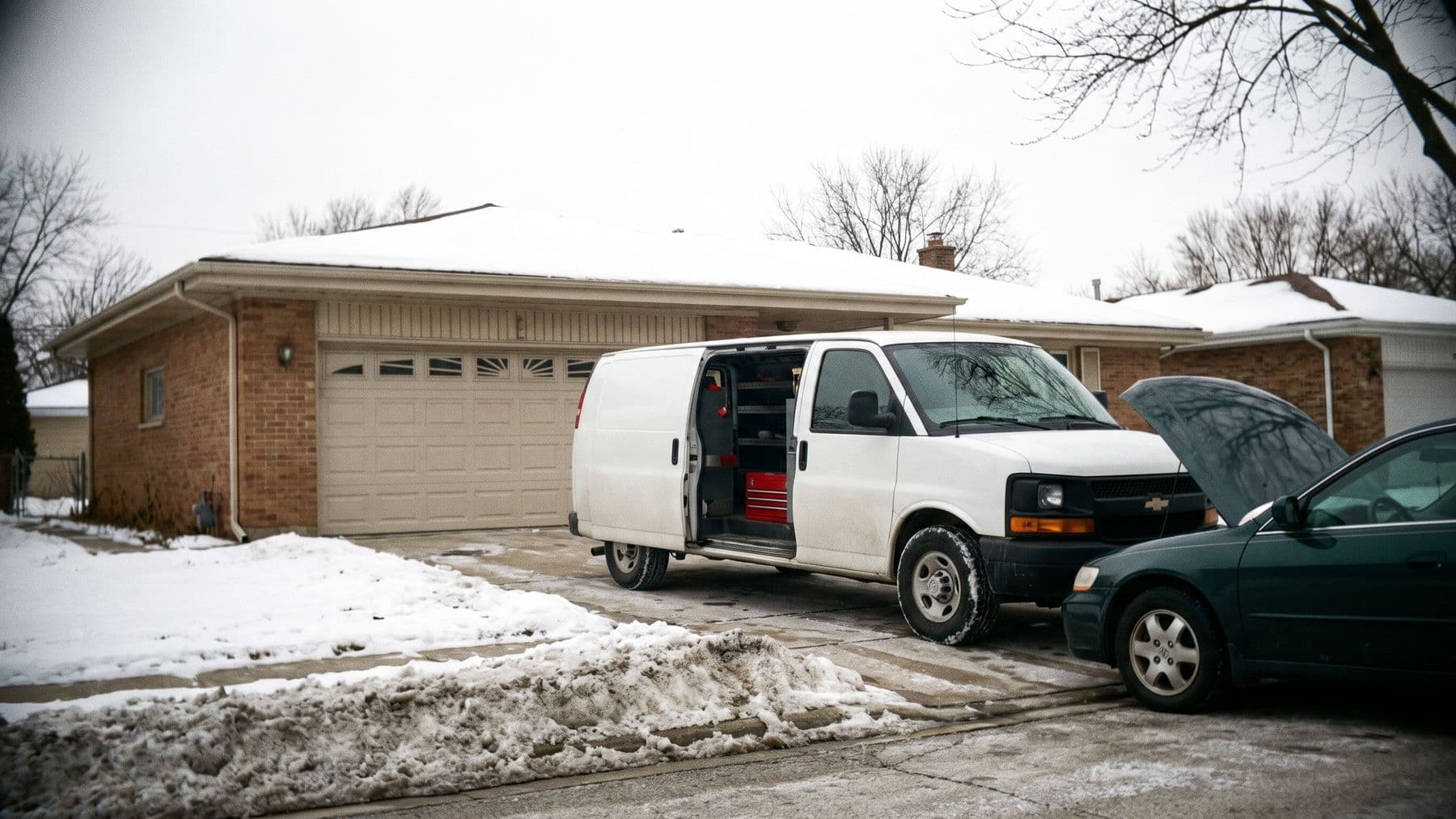
Ohio taxes automotive repair, and it gets there by taxing the repair itself rather than only the parts. The Revised Code defines a sale to include a transaction by which an item of tangible personal property is repaired, and the Department of Taxation confirms in its own words that repair services are taxable unless the item being repaired is exempt. A motor vehicle is tangible personal property, which the Department also states.
Chain those three together and the practical answer falls out. A brake job in Ohio is a taxable transaction on the whole of it, not a taxable part with untaxed labor attached. Somebody arriving from Texas, where itemizing the invoice leaves the labor alone, is the person most likely to get this wrong, and the error repeats on every job.
The second question hiding inside the first is which registration lets you collect. Ohio issues vendor licenses by county, and it has a rule for the case where there is no county to attach you to. A vendor with no fixed place of business who sells from a vehicle makes each vehicle a place of business, and the alternative to collecting a license per county is a transient vendor license that works statewide.
Keep the estimate, the invoice and the photos for every job in one place.
Starter $99/mo · Growth $149/mo · 14 days free on both plans. Cancel anytime.
The Revised Code taxes the act of repairing
Section 5739.01 defines what a sale is for Ohio sales tax purposes, and it is a long list. Most of it is what you would expect, transfers of property and the like. Then division (B)(3) adds a set of transactions that are sales because of what is done rather than what is handed over, and the first of them is repair.
The exception attached to it is narrow and worth reading. Repair is a sale except where the property being repaired is one whose purchase would not have been taxable in the first place. In other words the repair follows the thing: tax an item, tax its repair.
This is a structurally different design from a state that taxes parts and exempts service, and it is the reason the answer to the question at the top of this page is not the answer next door.
“An item of tangible personal property is or is to be repaired”
Ohio General Assembly, Ohio Revised Code section 5739.01(B)(3)(a), definition of sale. codes.ohio.gov/ohio-revised-code/section-5739.01. Read August 29, 2026.
The Department of Taxation says it in one line
The statute is the authority, but a statute is not what somebody reads at eleven at night before quoting a job. The Department of Taxation publishes a plain list of what is and is not taxable, and repair has a single line: taxable unless the item being repaired is exempt.
The same page settles the other half of the chain by defining tangible personal property and naming motor vehicles in the list. There is no separate motor vehicle repair regime to look for. A car is tangible personal property, repair of tangible personal property is taxable, and that is the whole argument.
The Department also has a tax education page specifically on auto repair. We could not read it: the page loads its body through the site portal and returned no content to us, so nothing on this page is quoted from it.
“Repair Services: Taxable unless the item being repaired is exempt.”
Ohio Department of Taxation, Sales and Use, Applying the Tax, taxable services. tax.ohio.gov/help-center/faqs/sales-and-use-applying-the-tax-what-is-and-isnt-taxable/sales-and-use-applying-the-tax. Read August 29, 2026.
“includes motor vehicles, electricity, water, gas, steam, and prewritten computer software”
Ohio Department of Taxation, Sales and Use, Applying the Tax, tangible personal property. tax.ohio.gov/help-center/faqs/sales-and-use-applying-the-tax-what-is-and-isnt-taxable/sales-and-use-applying-the-tax. Read August 29, 2026.
With no fixed premises, each vehicle counts as a place of business
Ohio vendor licenses are issued by county, one for each fixed place of business, which raises an obvious problem for somebody whose place of business is a van that crosses county lines all week. Section 5739.17 answers it directly, in a sentence that has clearly been sitting there for a long time.
Where a vendor has no fixed place of business and sells from a vehicle, each vehicle intended to be used within a county counts as a place of business for licensing purposes. The rule turns the van into the premises rather than pretending the premises question does not arise.
That is a fact about how Ohio counts, not a statement about what any particular mobile mechanic has to do. Whether a given operation is selling from a vehicle in the sense the section means is a question for the Department of Taxation and the county auditor, and both are easier to ask before the first job than after the first audit.
“if a vendor has no fixed place of business and sells from a vehicle, each vehicle intended to be used within a county constitutes a place of business for the purpose of this section.”
Ohio General Assembly, Ohio Revised Code section 5739.17, vendor license. codes.ohio.gov/ohio-revised-code/section-5739.17. Read August 29, 2026.
The transient vendor license is the statewide alternative
The same section offers a second route. Rather than collecting a county license everywhere it has no fixed place of business, a transient vendor may apply to the tax commissioner for one license that authorizes retail sales in any county where it has no fixed premises.
The definition of transient vendor is specific and is worth reading before assuming it fits. It is written around vending machines, titled vehicle leasing, and a person who transports stock to a temporary place of business, and a temporary place of business is defined in turn as somewhere occupied temporarily to make retail sales to the public.
We are describing what the section says rather than telling you which license applies to you. The section also gives the commissioner power to require a vendor to be licensed as a transient vendor where that suits administration of the tax, so this is not purely the vendor choice it first appears to be.
“The transient vendor's license authorizes the transient vendor to make retail sales in any county in which the transient vendor does not maintain a fixed place of business.”
Ohio General Assembly, Ohio Revised Code section 5739.17(D), transient vendor license. codes.ohio.gov/ohio-revised-code/section-5739.17. Read August 29, 2026.
The fee changed in 2025, and the Department says so on its own page
Fees on tax pages age badly, and Ohio is a live example. The Department of Taxation notes on its general sales and use information page that the vendor license application fee went up in April 2025, and names the old and the new figure.
The reason to quote the change rather than the number alone is that older Ohio pages and a great many third party guides still print the previous figure. If you find two different numbers, the Department page carrying the date is the one to trust, and the statute sets the same amount for both a county license and a transient vendor license.
“Effective April 9, 2025, new vendor's license applications increased from $25 to $50.”
Ohio Department of Taxation, Sales and Use, General Information, vendor license fee increase. tax.ohio.gov/help-center/faqs/sales-and-use-general-information/sales-and-use-general-information. Read August 29, 2026.
Is there an Ohio license for repair itself?
This page answers a tax question, and the licensing question is a different one that we have not tried to close. We looked at the state pages below and did not find a state license for general automotive repair, but we did not read the Revised Code exhaustively and are not claiming that none exists.
Ohio does license and register plenty of vehicle adjacent activity, from dealers to salvage, and county and city rules are their own layer on top. What is quoted above is about collecting tax, and it is not a statement about a right to do the work.
We looked and did not find one. Here is where we looked.
What we searched for: an Ohio state license, permit or registration for automotive repair businesses or mechanics. Searched on August 29, 2026.
What this page does not tell you
- County and transit sales tax rates, which sit on top of the state rate and vary by where the sale is sourced.
- Exempt customers and exempt vehicles, which exist and which change the answer for particular jobs.
- Whether any given operation is a transient vendor within the statutory definition, which is a question for the Department of Taxation.
- Ohio licensing for dealers, salvage and inspection work, which is separate from anything about collecting tax.
Questions people ask
Is repair labor taxable in Ohio?
The Revised Code makes a transaction by which an item of tangible personal property is repaired a sale, and the Department of Taxation states that repair services are taxable unless the item being repaired is exempt. A motor vehicle is on the Department list of tangible personal property.
What license lets a mobile mechanic collect Ohio sales tax?
Ohio issues vendor licenses per fixed place of business by county, and section 5739.17 says that a vendor with no fixed place of business who sells from a vehicle makes each vehicle used within a county a place of business. The section also provides a transient vendor license covering counties where the vendor has no fixed premises.
Does itemizing parts and labor separately change the Ohio tax?
Nothing we read on the Department pages quoted here makes the taxability of a motor vehicle repair turn on how the invoice is split. That is different from Texas, where the split decides who pays the tax on the parts. Ask the Department before restructuring an invoice on this point.
What does an Ohio vendor license cost?
The Department of Taxation states that new vendor license applications increased from $25 to $50 effective 9 April 2025. Older pages and third party guides still show the previous figure.
Who checked this, and what it is not
This page has not been reviewed by a licensed professional. It was written by reading the agency pages quoted above and nothing else. Every quote links to the page it came from and carries the date we read it, so you can check each one yourself, and the agency is the only thing on this page that is authoritative.
This is not legal, tax or accounting advice, and it does not tell you what you have to do. It describes what the agencies publish, on the date we read it. Rules change, and a rule can apply differently to two businesses that look alike. Check with the agency, or with a lawyer or accountant licensed in your state, before you act on anything here.
Sources on this page were last re-read on August 29, 2026. Found something out of date? Tell us and we will fix it or take the claim down.
Where a CRM fits into any of this
Starter $99/mo · Growth $149/mo · 14 days free on both plans. Cancel anytime.