New York
What are the rules for mobile auto repair in New York?
New York is a registration state, and unusually the DMV describes working at the customer location inside the category it registers. The paperwork is heavier than most people expect.
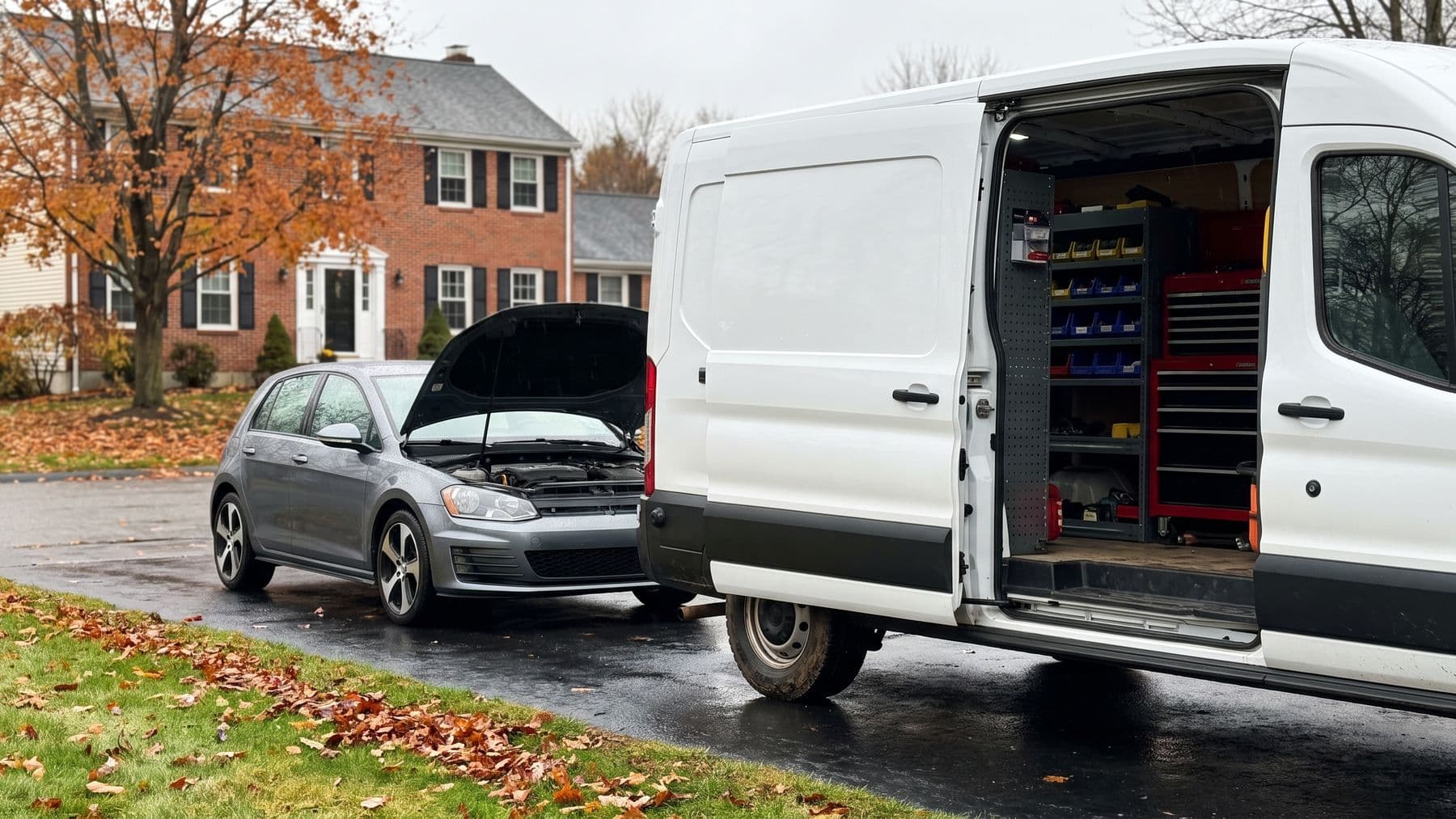
New York regulates repair through the Department of Motor Vehicles rather than a consumer affairs board, and it does so by registering the shop. The DMV publishes a description of each business type it regulates, and the entry for a motor vehicle repair shop puts registration and working at a customer supplied location in the same short list.
That is the answer to the question most mobile mechanics are actually asking. Working out of a van does not put you outside the category. On the DMV application page there is a separate note saying a mobile repair shop is investigated on site, which only makes sense in a system where a mobile operation is a registered repair shop with an unusual address rather than something else entirely.
The second half of the answer belongs to a different agency. New York taxes the whole repair bill, work included, and the Tax Department requires a repair operator to be registered with it before that can happen. The DMV application goes further and treats the tax registration as a prerequisite: the sales tax number and the Certificate of Authority are documents the DMV asks to see, which puts the two agencies in a fixed order.
Keep the estimate, the invoice and the photos for every job in one place.
Starter $99/mo · Growth $149/mo · 14 days free on both plans. Cancel anytime.
The DMV puts customer location work inside the category it registers
The Department of Motor Vehicles keeps a page describing every kind of business it regulates, so that an applicant can find which box they fall into before filling anything in. Under motor vehicle repair shops there are three bullets, and they run together: register with the DMV, repair or diagnose malfunctions, and work at a location the consumer provides.
Read as a set, that is a definition of the category rather than a list of options. New York is not carving out a separate mobile license and it is not excluding mobile work either. It is describing one registered business type that can happen at an address the customer supplies.
This matters because the instinct in most states is the opposite. Elsewhere the argument runs that a rule about shops cannot reach a van because a van is not a shop. On this page the DMV has already answered it.
“are required to register with the DMV to perform mechanical and/or body repairs”
New York State Department of Motor Vehicles, DMV-Regulated Business Type Descriptions, Motor Vehicle Repair Shops. dmv.ny.gov/transaction-message/dmv-regulated-business-type-descriptions. Read August 29, 2026.
“perform repairs at a location provided by a consumer”
New York State Department of Motor Vehicles, DMV-Regulated Business Type Descriptions, Motor Vehicle Repair Shops. dmv.ny.gov/transaction-message/dmv-regulated-business-type-descriptions. Read August 29, 2026.
A mobile shop is investigated on site
The application page for a repair or body shop lists the documents, then sets one sentence apart from the rest. It is the only line on that page that uses the word mobile, and it says a mobile repair shop draws an on site investigation.
The page does not say what the investigator looks at, and we are not going to guess. What the sentence establishes is narrower and more useful: the DMV expects mobile applicants, has a step for them, and processes them through the same repair shop registration as everybody else.
The practical reading is that the address question does not disappear because the work moves. It becomes the thing somebody comes and looks at.
“Note: Mobile Repair Shops require an on-site investigation.”
New York State Department of Motor Vehicles, Open and Operate a Repair or Body Shop. dmv.ny.gov/business/open-a-repair-or-body-shop. Read August 29, 2026.
The application is built around a property you can prove you may use
The heaviest part of the New York application has nothing to do with mechanical skill. It is documentary. The DMV asks for proof of permission to use the property at the business location, and lists the forms that proof can take, all of which are ways of tying a named person to a specific address.
Zoning is a second, separate document. The DMV publishes a zoning requirements letter for repair shops and asks for proof of zoning as described in it, which means a local authority has to agree that repair work is allowed where the application says it happens.
For somebody planning to run the business from a home address, these two items are where the reading time goes, and they are the reason a New York application is not something to start the week you buy the van. What the property has to look like for a mobile applicant is exactly the question the on site investigation exists to answer, and neither of the DMV pages we read states it in advance.
“proof that you have permission to use the property at the business location. This can be a notarized statement from the property owner, lease (may be contingent on facility approval), sub-lease with primary lease, mortgage, deed, or receipted tax bill.”
New York State Department of Motor Vehicles, Open and Operate a Repair or Body Shop, application documents. dmv.ny.gov/business/open-a-repair-or-body-shop. Read August 29, 2026.
“Do not submit your application if you do not have your Certificate of Authority.”
New York State Department of Motor Vehicles, Open and Operate a Repair or Body Shop, application documents. dmv.ny.gov/business/open-a-repair-or-body-shop. Read August 29, 2026.
New York taxes the labor, not only the parts
The Tax Department publishes a bulletin for auto repair and body shops, and its central sentence is one line long. Sales tax is collected on the total charge for parts and labor. There is no version of a New York repair invoice where the work is outside the tax because it was written on its own line.
That is the opposite of Texas, where itemizing moves the tax onto the parts alone and leaves the labor untaxed, and it lands in the same place as North Carolina by a different route. A pricing habit carried across a state line is the expensive kind of mistake here, because it repeats on every job until somebody notices.
The same bulletin puts the tools on the other side of the line. Equipment bought to do the work is taxable to the business that buys it, because it is used up performing the service rather than handed to the customer.
One exception is worth knowing because it looks like an inconsistency and is not. The charge for a New York State motor vehicle inspection is not taxable, while repairs needed to pass that inspection are.
“You must collect sales tax on the total charge for parts and labor for the repair services that you provide.”
New York State Department of Taxation and Finance, Tax Bulletin ST-40, Auto Repair and Body Shops. tax.ny.gov/pubs_and_bulls/tg_bulletins/st/auto_repair.htm. Read August 29, 2026.
“The purchase, lease, or rental of tools or equipment for your shop is taxable.”
New York State Department of Taxation and Finance, Tax Bulletin ST-40, Auto Repair and Body Shops. tax.ny.gov/pubs_and_bulls/tg_bulletins/st/auto_repair.htm. Read August 29, 2026.
“The charge for a New York State motor vehicle inspection is not taxable.”
New York State Department of Taxation and Finance, Tax Bulletin ST-40, Auto Repair and Body Shops. tax.ny.gov/pubs_and_bulls/tg_bulletins/st/auto_repair.htm. Read August 29, 2026.
Two registrations, and the order between them is not yours to choose
The Tax Department states that an operator of a repair or body shop is registered with it in order to collect and remit sales tax. Separately, the DMV asks an applicant for the sales tax identification number and a copy of the Certificate of Authority, and tells applicants not to file without one.
Put the two sentences next to each other and the sequence stops being a matter of preference. The tax registration is a document the vehicle registration application consumes, so a plan that leaves the tax side until after the DMV approval is a plan that stalls at the first envelope.
“you must be registered with the Tax Department to collect and remit sales tax.”
New York State Department of Taxation and Finance, Tax Bulletin ST-40, Auto Repair and Body Shops, registration. tax.ny.gov/pubs_and_bulls/tg_bulletins/st/auto_repair.htm. Read August 29, 2026.
What we could not find: the fee
The DMV application page tells applicants to send all required fees by check payable to the Commissioner of Motor Vehicles and prints no figure. The figures live in the repair shop requirements document and the commissioner regulations, both of which the DMV publishes only as PDF files that our text extraction could not read.
So this page carries no New York fee. A licensing page with a wrong number on it is worse than one that says it does not know, and the agency publishes the current schedule on the pages linked below.
We looked and did not find one. Here is where we looked.
What we searched for: the current New York repair shop registration and renewal fee, in a form we could read and quote. Searched on August 29, 2026.
What this page does not tell you
- The Motor Vehicle Repair Shop Regulations, published as CR-82, which set out sign, record and estimate rules in more detail than the summary pages we quoted.
- City rules, which in New York City in particular are their own layer and are administered by the Department of Consumer and Worker Protection rather than the state.
- Vehicle inspection station licensing, which is a separate DMV business type with its own qualifications.
- The New York State Waste Tire Management Fee, which the tax bulletin mentions and which we have not sourced here.
Questions people ask
Does a mobile mechanic in New York need a repair shop registration?
The DMV describes a motor vehicle repair shop as a business required to register with the DMV to perform mechanical or body repairs, and includes performing repairs at a location provided by a consumer in the same description. Read that page, and the application page, before deciding how it applies to you.
Is repair labor taxable in New York?
The Tax Department bulletin for auto repair and body shops states that sales tax is collected on the total charge for parts and labor. That is different from Texas, where itemizing leaves the labor untaxed.
Which registration comes first, the DMV one or the tax one?
The DMV application asks for the sales tax identification number and a copy of the Certificate of Authority, and says not to submit the application without the Certificate. The Tax Department registration therefore has to exist before the DMV one is filed.
Can a New York customer approve extra work over the phone?
The DMV page says a repair may be authorized by telephone and that the time, the date and the name of the person who gave the authorization are recorded when it is. It also says the final bill cannot exceed the written estimate without the consent of the customer.
Who checked this, and what it is not
This page has not been reviewed by a licensed professional. It was written by reading the agency pages quoted above and nothing else. Every quote links to the page it came from and carries the date we read it, so you can check each one yourself, and the agency is the only thing on this page that is authoritative.
This is not legal, tax or accounting advice, and it does not tell you what you have to do. It describes what the agencies publish, on the date we read it. Rules change, and a rule can apply differently to two businesses that look alike. Check with the agency, or with a lawyer or accountant licensed in your state, before you act on anything here.
Sources on this page were last re-read on August 29, 2026. Found something out of date? Tell us and we will fix it or take the claim down.
Where a CRM fits into any of this
Starter $99/mo · Growth $149/mo · 14 days free on both plans. Cancel anytime.