For independent garages
Shop management software for a small independent garage
Fixty is built for one mechanic working alone. If your garage has a counter, a parts shelf and technicians splitting a job between them, this is the wrong tool, and the rest of this page is about which ones are not.
Shop management software for a one or two person garage keeps the repair order at the centre of the day: the customer and the car it belongs to, the estimate the owner agrees to, the labor and parts on the job, and the invoice and payment that close it. At that size it mostly replaces the paper ticket, the phone call to get a yes, and the evening spent working out which payment belongs to which car.
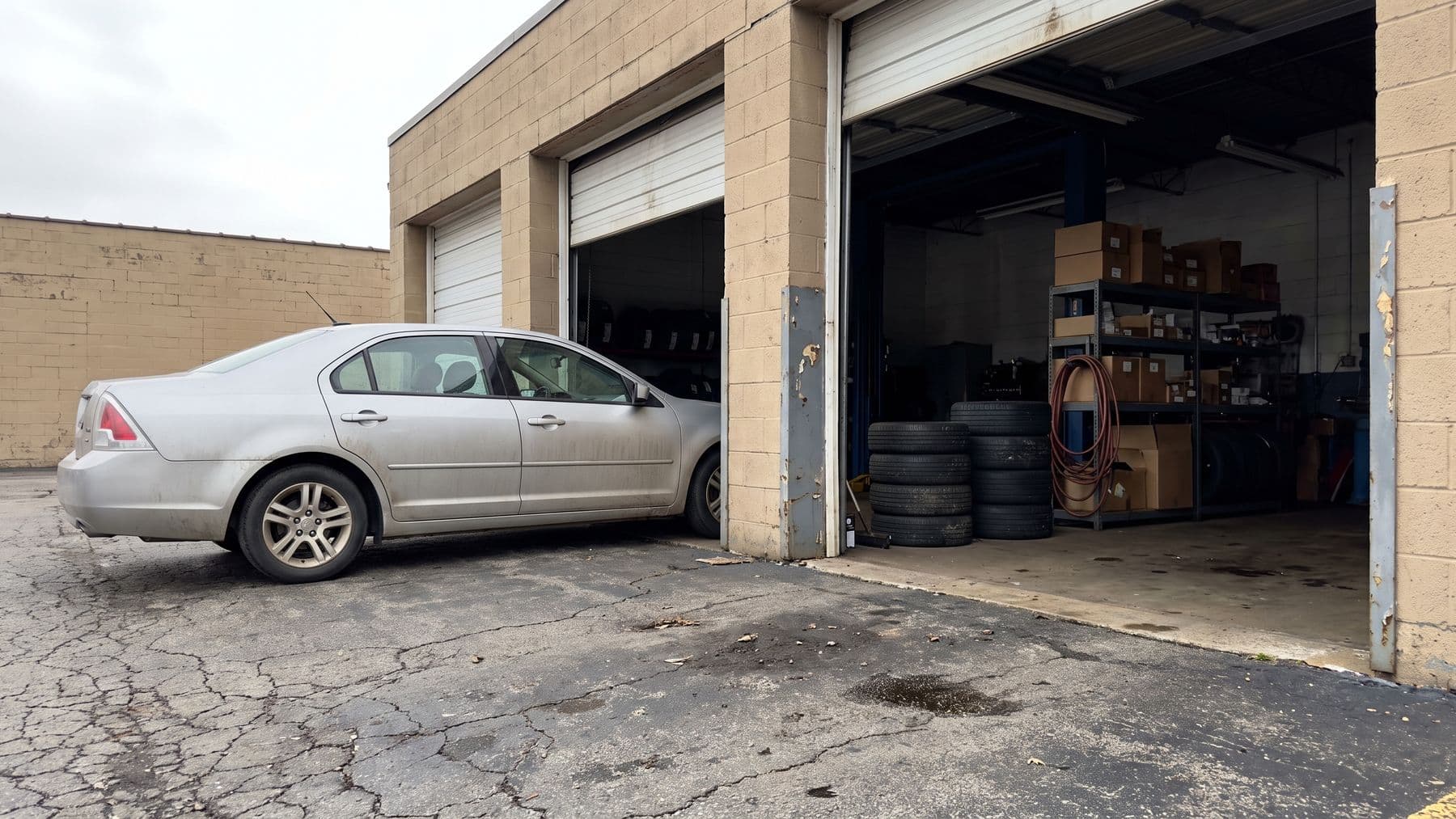
The phrase people type is shop management software for a small independent garage. The honest answer, for most of the people typing it, is not Fixty.
A garage that is running properly needs a few things this product does not have. Work divided between named technicians. Parts counted on a shelf and reordered when they run low. The day taken off the board and dropped into the bookkeeping without anyone retyping it. Fixty tracks one job, one estimate, one inspection, one invoice and one payment, for one person. That is the whole shape of it, and it is deliberate rather than a gap being hurried closed.
So this page does the thing the rest of your search results will not do: it tries to talk you out of it first, and it names the software you should be looking at instead.
A day in a one bay garage
This is the version of a shop day that Fixty actually fits: one person, one bay, keys handed over in the morning and back in the afternoon.
The car arrives
The job goes on the board with the customer and the vehicle attached. If the car has been in before, its history is on the vehicle record: what you did, what you charged, what you told them was coming.
Before you start
The estimate goes out as a link while the owner is at work. They approve the lines they want from their desk, and the job is set to approved without a phone call either of you had time for.
While the car is up
The inspection is done on the phone, with photographs. The second job gets sold by the picture rather than by a speech at the counter, which is the one shop advantage a solo operator can actually match.
Waiting on a part
You set the job to waiting on parts. It is not finished, it is not forgotten, and the status change is in the job history if anyone asks later when it stalled.
Handing the keys back
The work order becomes the invoice with every line carried over, and the customer pays by link. No card terminal, no printed ticket, no evening spent copying tickets into a spreadsheet.
What a one person garage actually gets
Each row is an axis Fixty is measured on across this site, so the wins below are printed from the same record as the losses further down.
Job pipeline board
Cars in the lot, cars on the lift, cars waiting on parts and cars waiting to be paid for, on one board instead of on a whiteboard nobody updates after lunch.
Digital estimates and quotes
Labor at your rate, parts at your markup, tax on the parts, the labor or the whole job as you set it once, built from a service library rather than typed fresh every morning.
Photo vehicle inspections
Included on every plan, not an upgrade.
Photographs are how a small garage earns the trust that a dealer buys with a waiting room. They cost you nothing and they travel to the customer by text.
Card payments
Stripe, paid from the same link as the estimate.
A payment link is a card machine you did not lease, and the payment lands attached to the job that earned it.
Price published without talking to sales
You can see the price of this software on the pricing page and decide alone. Several of the products aimed at your garage will not quote you without a call first.
The four rows that will decide this for you
These are not caveats at the bottom of a page. For a garage, each one is a reason to close the tab, and the caveats are printed straight from the record every comparison table on this site reads.
Multi technician teams: no
One mechanic, one workspace. Built solo first on purpose.
Parts inventory management: no
Fixty tracks parts on a job, not stock on a shelf.
Accounting sync: no
No QuickBooks or Xero integration today.
Tire and wheel shop tools: no
- There is no service writer view and no counter mode. One workspace, one login, and sharing a login between two people is not multi user support no matter how it is sold.
- There is no time clock, no technician efficiency reporting and no payroll. If you measure billed hours against clocked hours, that number does not exist here.
If two of those are true of your garage, skip down to the section that names the three products built for a shop like yours. Nobody is well served by you finding this out after you have already moved your customer list.
The four rows as a table, with prices
Here is the section above laid out against Tekmetric, Shopmonkey and AutoLeap, the three shop systems this page names, with what each publishes about price and trying it first. Read the technician and parts rows before the price rows. If either one has to be a yes for your garage, the Fixty column has already answered you.
Vendor pages read between August 29, 2026 and November 10, 2026.
| Compared | FixtyThis is us | TekmetricFixty vs Tekmetric | ShopmonkeyFixty vs Shopmonkey | AutoLeapFixty vs AutoLeap |
|---|---|---|---|---|
| Lowest monthly price the vendor publishes | $99 per month | $179 per monthsource | $215 per monthsource | $179 per monthsource |
| Same plan, paid month to month | $99 per month | We looked and could not confirm this. | We looked and could not confirm this. | We looked and could not confirm this. |
| How you can try it before paying | 14 day free trial on both plans | Free demo and self guided tours. No free trial.source | Demo walkthrough, about 30 minutessource | Demo only, no free trial of the shop softwaresource |
| Multi technician teams | No | Yessource | Yessource | Yessource |
| Parts inventory management | No | Yessource | Yessource | Yessource |
| Accounting sync | No | Partialsource | Yessource | Yessource |
| Tire and wheel shop tools | No | Yessource | Yessource | Yessource |
Every cell for another product was read from that vendor's own site, and its source link opens the page it came from. The first price row is the lowest monthly figure each vendor publishes, which can be the rate for paying a year at a time; the second is the same plan with no commitment, where the vendor states one. Where a cell says we could not confirm something, we did not find it, which is not the same as it not existing. Fixty's cells describe our own product: Starter is the cheaper of our two plans and is billed monthly.
What shop software is actually selling you
It is worth being precise about what the category does, because the feature lists all blur together and the thing they have in common is easy to miss.
Shop management software sells a shared queue. Somebody at the front takes the call, writes the ticket and promises a time. Somebody in the back picks the ticket up, does the work and hands it back. The software is the seam between those two people: it is what stops the front desk promising a car back at a time the bay has not started, and it is why every one of those products is organized around repair orders moving between named humans.
Everything else the category sells hangs off that seam:
- Parts inventory exists because the person ordering is not the person fitting, so the shelf has to be a shared fact rather than something one mechanic knows.
- Technician assignment and efficiency reporting exist because somebody is accountable for hours that somebody else worked.
- Accounting sync exists because the volume is past the point where one person retyping it in the evening is sane.
- The counter workflow exists because a customer is physically standing in front of somebody who is not the mechanic.
Fixty sells none of that, because it assumes there is no seam. One person takes the call, writes the estimate, does the work and gets paid, so there is nothing to hand across and nothing to keep in sync. That is a real advantage when it is true of you, and a hole straight through the middle of the product when it is not.
Which is why the test is not a feature comparison. It is one question: is there a handover in your garage? If there is, buy for the handover.
What the other names in your search results are built for
Three of the products a garage owner meets in this search are genuinely shop native. Below is each one describing its own buyer, quoted from its own website with the page and the date, alongside the cheapest price it publishes without a sales call. We did not paraphrase any of it, and where a company does not publish something, the cell says we could not confirm it rather than guessing.
Tekmetric
Who they say it is for
Shops including mobile mechanics, single shop businesses and franchises.
“Yes! We proudly support thousands of shops including mobile mechanics, single shop businesses, and franchises. Tekmetric is cloud-based so you can access Tekmetric from anywhere on any device.”
tekmetric.com/feature/estimate-building, read November 10, 2026
Cheapest published monthly price
$179 per month
“Tekmetric starts at $179 per month when billed annually.”
tekmetric.com/ai-info, read November 10, 2026
The one to look at first if the reason you are shopping is that two people need to work the same repair order.
Shopmonkey
Who they say it is for
Auto repair shops of every size, from a single shop to franchise groups
“Built for every type of shop, whether you run one or a thousand.”
shopmonkey.io, read November 10, 2026
Cheapest published monthly price
$215 per month
“Simple pricing for auto repair and shop management software. Shopmonkey offers plans starting from just $215/month with annual pricing discounts.”
shopmonkey.io/pricing, read November 10, 2026
Built around the shop as an organization, up to groups of them. Heavier than a one bay garage needs, and honest about who it is for.
AutoLeap
Who they say it is for
Auto repair shops of every type and size, from a single bay to multi location franchises, with mobile mechanics listed as one of the shop types they serve.
“From a single-bay shop to high-volume quick lube, from mobile mechanics to tire shops managing seasonal inventory, AutoLeap is built for how your shop actually runs.”
autoleap.com, read November 10, 2026
Cheapest published monthly price
$179 per month
“Power your shop with #1 Auto Repair Software starting at $179/mo. Flexible monthly and annual plans designed to streamline operations for shops of any size.”
autoleap.com/pricing, read November 10, 2026
Names the single bay shop and the tire shop in the same breath, so a small independent garage is inside their stated market rather than at the edge of it.
We sell competing software, so read those quotes rather than our summary of them. Each links to the page it was taken from.
What a small shop needs on day one, and what can wait
It is easy to buy software for the shop you hope to have in three years, and that is how a one bay garage ends up paying for technician scheduling it will not use until it hires. A better question is what has to be true on the first Monday, and what only starts to matter once the work is more than one person can hold in their head.
On day one, the list is short, and none of it depends on how many people work there:
- A record for each customer and each car, so the next visit starts from what you did last time rather than from the customer trying to remember.
- An estimate the owner can read and approve from wherever they are, instead of a call you have to catch between jobs.
- A way to be paid that does not depend on the customer coming back to the counter, and a record of what was paid and against which job.
- Photographs of what you found, kept with the car and sent to the owner as a link.
- One place that says where every car in the lot is, so nothing waits on a part for a week because nobody wrote it down.
Two of those, as they look in the browser on demo data: the customer with their cars, plates and VINs, and a work order with its parts checked off as they arrive.
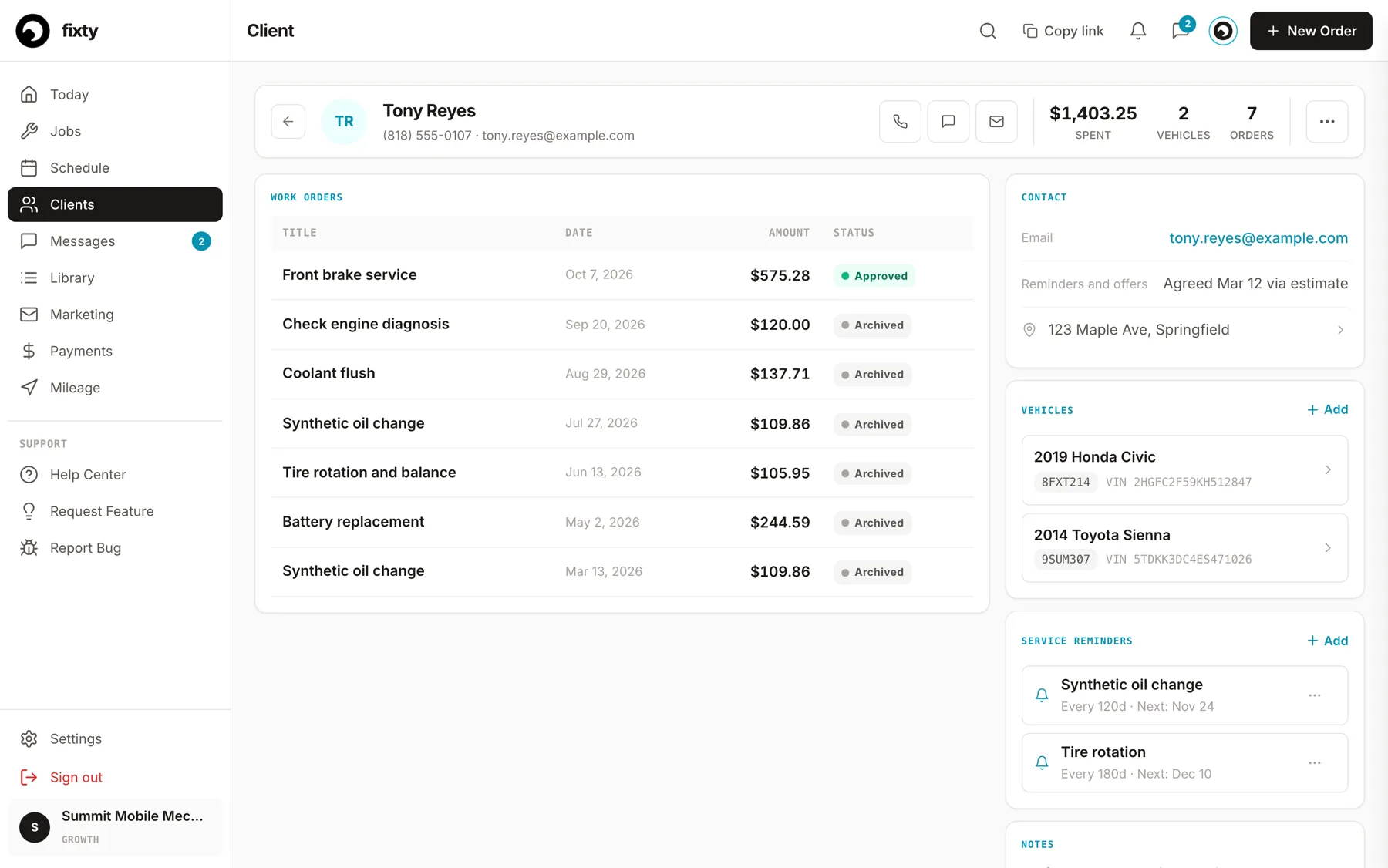
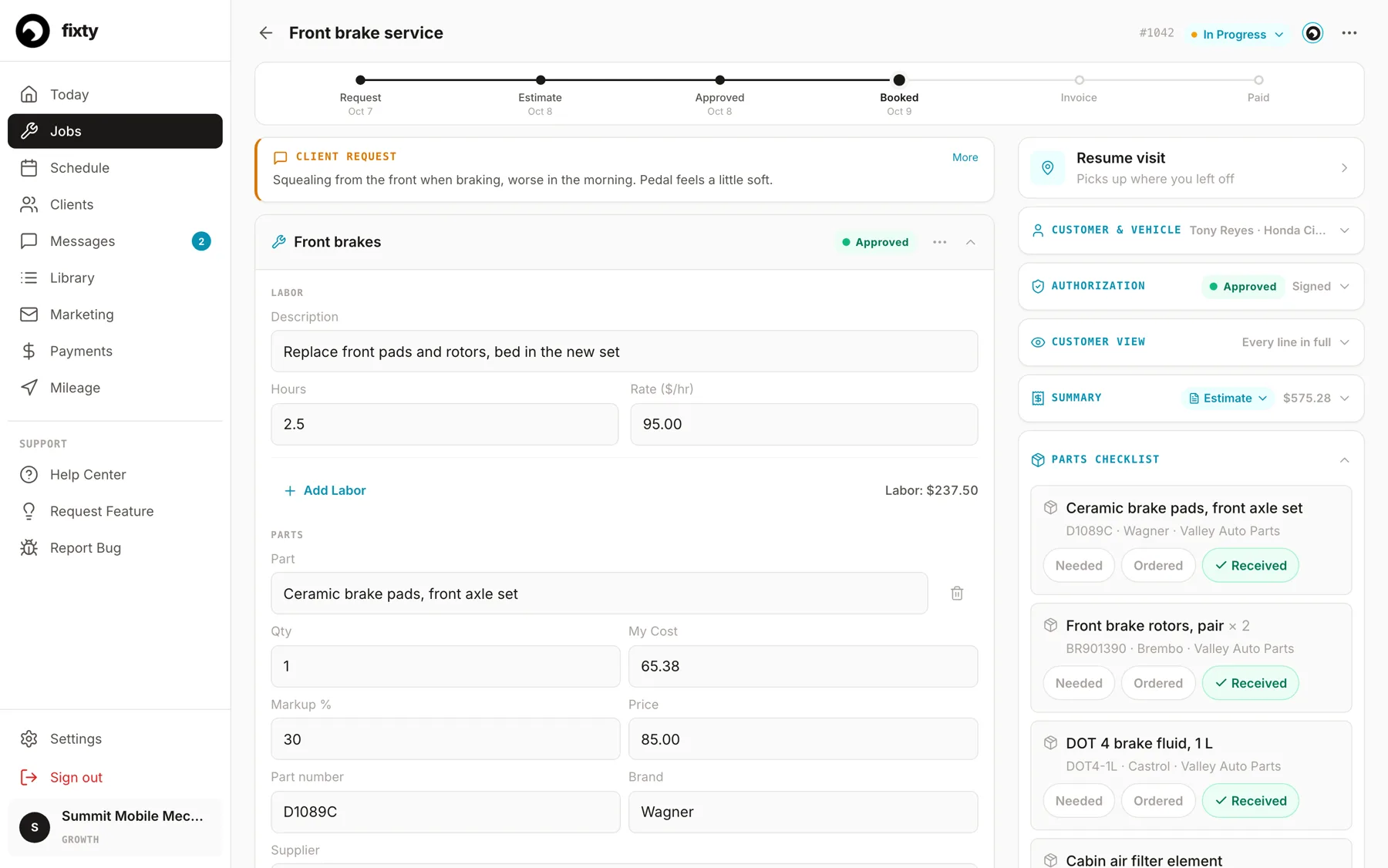
Everything above is what Fixty is built around. What can wait is the machinery that exists to coordinate more than one pair of hands, and it becomes worth paying for in a rough order:
- When a second technician starts: jobs assigned to a named person, their own login, and some way of seeing who did what.
- When the parts shelf is bigger than you can remember: stock counts, reorder points and a supplier you order from inside the software.
- When the books take an evening a week: a link from the invoices to your accounting package.
- When somebody other than the mechanic answers the phone and writes the ticket: a counter view and a service writer.
Fixty covers the first list and none of the second. If you are a long way from the second list, the sensible order is to run the first list properly now and buy for the second when you reach it, rather than carrying the weight of a full shop system through the months when it earns you nothing. If you are already at the second list, skip this page, and the trial.
The garage Fixty does suit
There is a real version of a small independent garage that this fits, and it is worth naming precisely so you can tell whether it is you.
- You rent a unit and you work in it alone. The building is where the tools live, not where a team works. What you needed was never shop management, it was a way to stop losing jobs and chasing money.
- You went back to working solo on purpose, after a crew. You know exactly what you are giving up, and paying for seats and shop reporting you no longer use is what you are trying to stop doing.
- Most of your work is mobile and the unit is for the jobs that cannot happen in a driveway. Fixty was built for the mobile half and does not mind the other half.
- You have a helper who hands you tools and does not write repair orders. That is one person writing the work, which is what this product assumes.
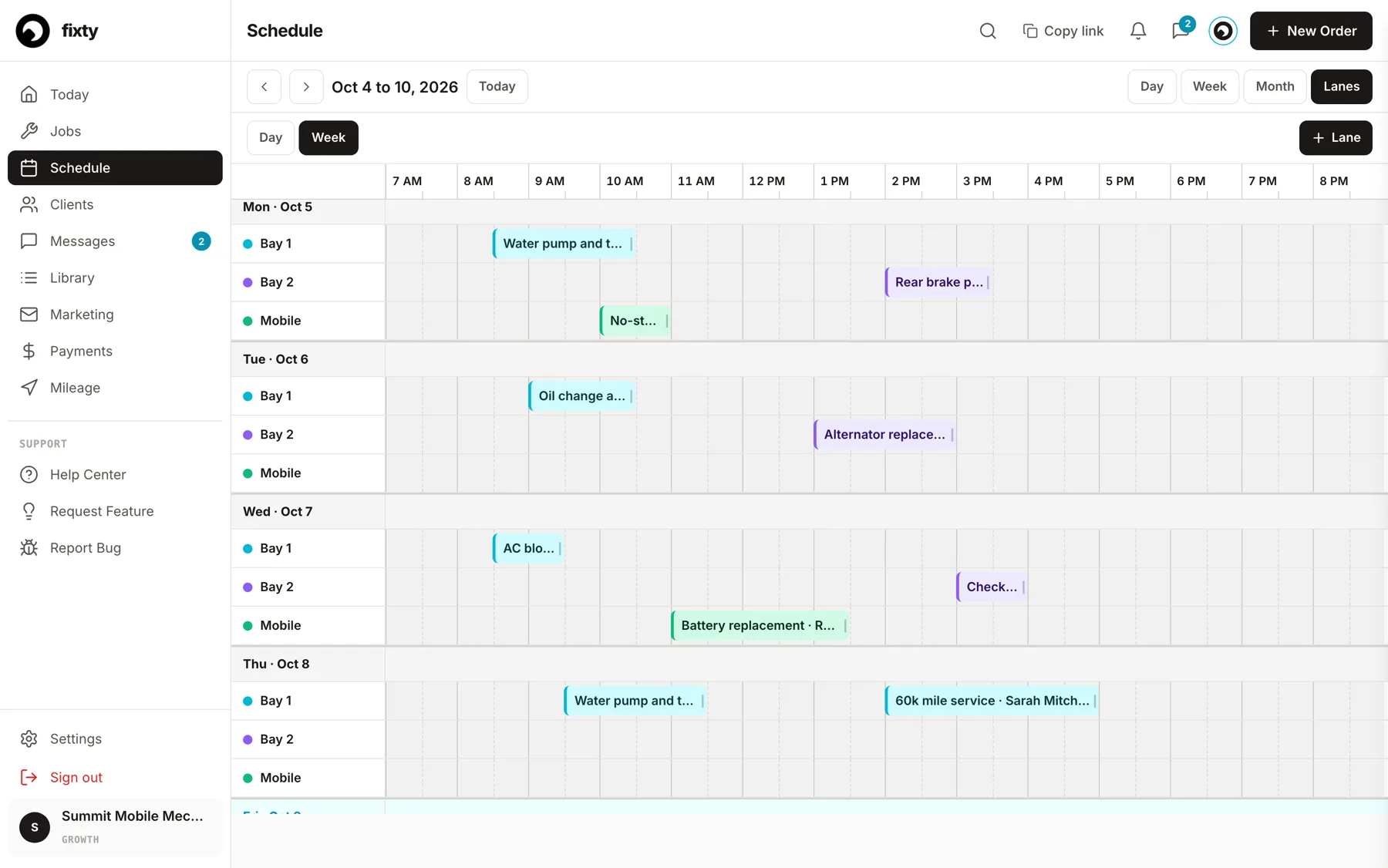
If the unit and the van share one diary, the schedule can be split into lanes, one for each bay and one for the road, so a week reads at a glance. A lane is a label on the calendar, not a login: it shows where a job is booked, and nobody signs in as a lane.
What all four have in common is that one person is accountable for every job from the estimate to the payment. The moment that stops being true, the software you need is a different category of thing.
Questions people ask before they sign up
Can two of us use the same Fixty account?
There is one workspace and one login. Two people can share it, but nothing in the product knows which of you did what, jobs cannot be assigned, and the history will not tell you who changed a status. That is not multi user support and we are not going to describe it as though it were.
Does Fixty sync with QuickBooks or Xero?
No. There is no accounting integration of any kind today. Invoices and payments live in Fixty and somebody moves the numbers across by hand.
Does it do parts inventory?
No. Parts are line items on a job: description, quantity and price. There is no stock level, no reorder point, no supplier record and no purchase order.
We do shop work and mobile calls. Does that change the answer?
It can. If the mobile side is the growing half and one person runs it, Fixty fits that half well and will not get in the way of the rest. If the shop is the business and the van is an errand, buy for the shop.
Are shop features coming?
We are not going to give you a date, because a roadmap is the cheapest thing a software company can hand out and the easiest to quietly drop. Buy Fixty for what is on this page today, or buy something else.
How much should a small shop expect to pay for shop software?
Fixty is $99 a month on Starter and $149 a month on Growth. A plan covers one workspace, and nothing is charged per bay or per technician. Software built for a crew is usually priced by the size of the shop or the number of users, and a headline figure can depend on how you pay and who is counted, so read the quote printed beside each figure in the section above before you compare it with anything. Both Fixty plans open with a 14 day free trial: no card is needed to start, and nothing is charged until you add one.
Does a one or two bay shop need shop software at all?
Not always. If one person writes every job, a notebook and a spreadsheet will carry you a long way. Software starts to earn its keep when estimates go unanswered because nobody followed up, when you chase payments you could have taken at the counter, or when you cannot say what you told a customer last time. Past that, the thing that decides it is the handover: a second technician or a parts shelf is where a shop system stops being optional.
Can I switch without losing my customer and vehicle history?
Partly, and it helps to know which part. If your old system can give you a file of customers, Fixty takes a CSV or vCard through the Import customers button on the Clients list, brings in names, phone numbers and emails, and skips numbers it already has. Support will also load a list with you. Vehicles and past repair orders do not come across that way. You add each car to its customer once, and a VIN fills in the make, model and engine for you. Keep the old system readable until the cars that matter have been through your doors again.
Is there a free version of Fixty?
No. There is no free plan, and we would rather say so than hide it under a trial. Starter and Growth each start with 14 free days, and no card is needed to start, and nothing is charged until you add one. On day 14, without a card on file, the account turns read-only and nothing is charged. Add a card in Billing any time to pick up where you left off.
Does it run on a tablet at the bench, and is there an app?
The Fixty app on the App Store and Google Play is made for a phone, not laid out for a tablet. On a tablet, or on the computer in the office, open Fixty in the browser instead. It is the same account with the same jobs, so a job you started on the phone in the bay is already on the bigger screen when you write it up.
Is there a contract, or a fee to leave?
Neither. Each plan has one monthly price and there is no yearly term to sign up for. If you cancel, the plan stops renewing and you keep using it until the end of the month already paid for. Nothing is charged per bay, per seat or for setting up.
What does Fixty not do for a shop with bays?
It does not give each technician a login or a queue of assigned jobs, keep stock counts or reorder points, look up a supplier catalog or order parts from one, price labor from a labor guide, run an employee time clock or payroll, offer a counter view, or sync to QuickBooks or Xero. The schedule can show one lane per bay or per person, and a visit records when work started, but neither tells you who did the work. What it does keep for parts is a part number, a brand and a supplier typed on each line, and a status that moves from needed to ordered to received, so a car waiting on a part stays visible.
What does Fixty cost, if we do decide to try it?
Starter is $99 per month and Growth is $149 per month. Both come with a 14 day free trial, and on both no card is needed to start, and nothing is charged until you add one. Growth is where the dedicated text number, the recurring reminders and the review requests live; the assistant is on either plan. Cancel any time; access runs to the end of the cycle you paid for.
Still think it fits?
The trial is the real test, and it takes one job to run it: put the next car through Fixty end to end, estimate to payment, and see what it cannot do while it is still cheap to find out.
Try Fixty free for 14 days